The Basics of Church Governance: Faithful Structures for Healthy Ministry
Most pastors do not enter ministry because they are passionate about writing bylaws, developing policies, or managing organizational systems. They feel called to preach God’s Word, shepherd people, make disciples, and lead the church to make a difference in the world.
Every pastor eventually discovers that a congregation’s spiritual life is shaped, in part, by the structures that guide its life together. These structures “should be defined” in the congregation’s governance documents. Governance documents clarify authority, define expectations, and guide decisions when questions or tensions arise.
When authority is unclear, expectations are assumed, documents are outdated, and decisions depend on whoever happens to be in the room, church leaders spend valuable energy managing confusion instead of leading ministry.
Healthy governance does not replace prayer, preaching, discipleship, evangelism, or pastoral care. It supports them by creating the clarity and trust needed for ministry to flourish.
Governance Is Not a Distraction from Ministry
Church governance is primarily an administrative matter, but it is deeply rooted in pastoral care. A church’s governing documents help answer basic questions: Who are we? What do we believe? How do we make decisions? Who has authority? How are leaders selected and held accountable? What happens when conflict arises? How do we protect people, steward resources, and move forward with integrity? These are not merely business questions. There are questions about caring for God’s people and about the faithful stewardship of the church.
Good governance isn’t about creating a corporate culture within the church. Instead, it means providing appropriate structure to ensure the church can effectively fulfill its mission while fostering harmony and accountability. As Paul states in 1 Corinthians 14:40, everything should be done decently and in order. This principle doesn’t turn administration into the focus of ministry, but it reminds us that disorder isn’t spiritually neutral. Disorder can drain leaders, cause unnecessary conflicts, and hinder healthy change.
The Basic Governance Priorities
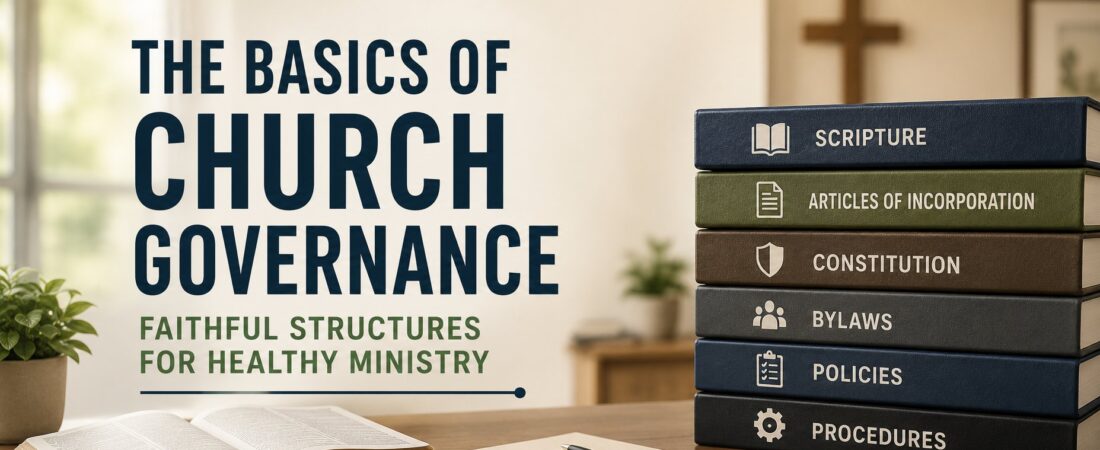
One helpful way to understand governance is to think in layers. Each layer should serve a distinct purpose. When the layers are confused or overlap, churches either become overregulated or underprotected. When the layers are clear, the church can maintain both stability and flexibility.
- Scripture – At the broadest level, the Bible is the foundation. The church belongs to Christ, not to its leaders, members, committees, or those who give. Every governance document should be evaluated to determine whether it supports faithfulness to scripture and the Great Commission.
- Articles of incorporation – Articles of incorporation are civil documents. They establish the church’s legal existence under state law. These documents usually include the legal name, purpose, registered agent, and provisions related to assets and dissolution. They should not become a place where the church carelessly inserts detailed ministry procedures or doctrinal language that may later be difficult to amend. Churches should review them with qualified legal counsel.
- Constitution – When used, a constitution defines the church’s foundational identity. It may include the church’s purpose, doctrinal commitments, membership foundation, and basic authority structure. A constitution should be durable. It should not regulate daily ministry activity.
- Bylaws – Bylaws are the main governing rules for the church’s internal operations. They explain how decisions are made, how leaders are selected, how meetings are conducted, how authority is exercised, and how accountability functions. Bylaws are not meant to answer every operational question. They are meant to provide the framework that keeps the church clear and consistent.
- Policies – Policies explain what should happen in specific areas of church life. They help leaders handle recurring or important matters consistently. Examples include personnel, finances, facility use, child protection, conflict of interest, safety, benevolence, communications, and volunteer screening.
- Procedures – Procedures explain how policies are carried out. If the policy says what should happen, the procedure explains the steps. Procedures should be clear enough that staff and volunteers know what to do, but flexible enough to adapt when circumstances change.
Why Clear Documents Matter
Churches often operate for years on memory and tradition. Someone remembers what happened last time. A longtime volunteer knows who should be called. A committee assumes it still has authority because it always has. These informal systems may seem to work during calm seasons, but they are fragile. Leadership transitions, growth, conflict, facility expansion, staff changes, or a crisis can quickly expose the weakness of undocumented assumptions.
Clear documents reduce anxiety. They help staff know what authority they have. They help members understand how decisions are made. They help committees and teams know their role. They help pastors lead without carrying every question personally. They also protect the church from inconsistency, favoritism, and unnecessary risk.
Clear documents do not guarantee health. A church can have strong documents yet still lack humility, trust, or courage. But unclear documents almost always increase the strain on leadership. During seasons of revitalization or growth, clarity in governance becomes even more important because change requires trust. People are more likely to follow leadership through change when they believe the process is both faithful to scripture and clear.
Policies Should Protect and Empower
Many churches think of policies only as restrictions. Healthy policies do more than tell people what they cannot do. They protect the church by clarifying expectations before confusion develops. They empower leaders by giving them a trusted framework for action. They help volunteers know how to serve well. They also help ensure that similar situations are handled consistently across the church.
A good policy does not need to be long. In many cases, a policy should be brief and focused. It should state the church’s expectation, identify the responsible role or team, and point to the procedure or resource that explains how to implement it. If a policy tries to include every step, exception, and form, it becomes difficult to maintain.
The most helpful policy systems include a process for creation, implementation, and review. Policies should not simply appear because one person wrote them. They should be developed with input from appropriate leaders, reviewed for legal or practical concerns when needed, approved by the proper body, communicated to those affected, and revisited regularly. Without a review process, old policies accumulate and eventually lose credibility.
Governance Must Match Real Life
One of the most common governance problems is the gap between what the documents say and how the church actually functions. A church may have bylaws that assign authority to a committee, but in practice, a staff member makes the decision. A policy may exist on paper, but no one knows where to find it. A procedure may describe a process that no longer fits the current ministry structure.
This gap is not always the result of rebellion or neglect. Churches grow. Staff changes. Ministries expand. Technology evolves. Community needs shift. What was effective when the church was smaller might not be suitable for a larger or more complex church. The problem arises when leaders never pause to align the documents with reality.
A basic governance review should ask simple questions. Are our documents current? Are they understandable? Do they reflect how decisions are actually made? Do staff and volunteers know where to find guidance? Are policies applied consistently? Are responsibilities assigned to roles rather than dependent on personalities? Would a new leader understand how to function if they started tomorrow?
A Simple Starting Point
Church leaders do not need to fix everything at once. A wise starting point is to gather the key documents, identify the current decision-making realities, and name the areas where confusion most often occurs. Start with the questions people keep asking. Look for repeated tension. Pay attention to areas where leaders say, We are not sure who decides that, or We have always done it this way.
From there, leaders can prioritize based on need or potential liability. Some churches need a bylaw review. Others need a policy manual. Others need procedures for facility use, volunteer screening, benevolence, or financial approvals. The goal is not to create paperwork. The goal is to create clarity that helps the church serve people faithfully.
Conclusion
The basics of church governance are not complicated, but they require attention. A healthy church needs documents that are faithful to scripture, clear in practice, aligned with real ministry, and maintained over time. Governance is not the mission of the church. The Great Commission is the mission. But healthy governance helps the church pursue that mission with trust, unity, and integrity. When leaders steward these structures well, they are not stepping away from pastoral ministry. They are caring for the flock by creating an environment where ministry can flourish.
Questions for Church Leaders
1. Do our governing documents clearly explain how authority is exercised in our church?
2. Are our constitution, bylaws, policies, and procedures serving different purposes?
3. What decisions create the most repeated questions or tension?
4. Are our policies written, accessible, and consistently followed?
5. If a key leader left tomorrow, would the church know how to carry on their responsibilities?
About the Author
Brad Gwartney, DMin, serves as Executive Pastor of Stetson Baptist Church in DeLand, Florida. He has more than 25 years of ministry experience in local church leadership, administration, operations, and governance. Brad is the author of Faithful and Clear: A Pastor’s Guide to Church Governance, a practical resource designed to help pastors and church leaders strengthen constitutions, bylaws, policies, and procedures. He also serves as a trustee of the Ethics and Religious Liberty Commission of the Southern Baptist Convention. Brad and his wife, June, have two children, Lydia and Will. To learn more about Faithful and Clear or to access free church governance resources, visit www.bradgwartney.com. To contact Brad directly, email him at brad.gwartney@gmail.com.