
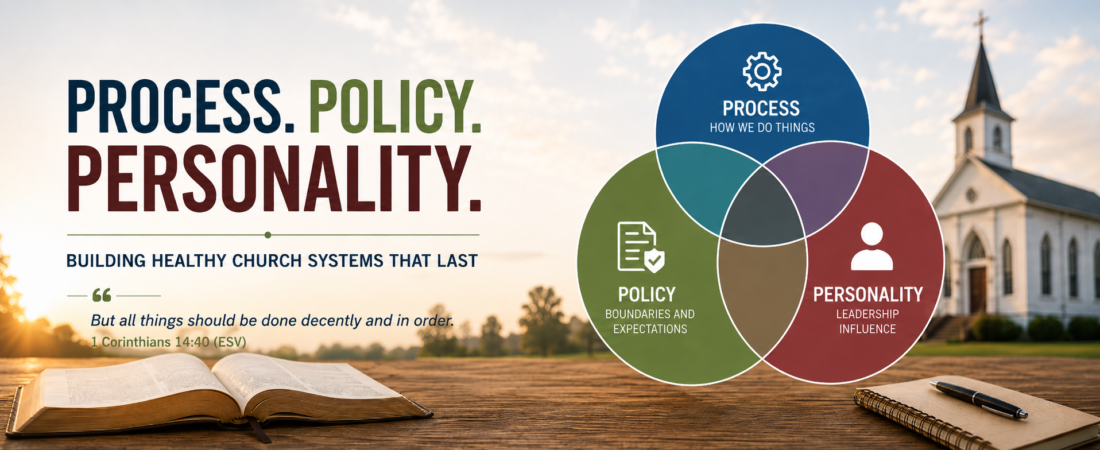
Process, Policy, Personality: Building Healthy Church Systems That Last
Every church has a unique system or way of doing things. This includes, but is not limited to, how services are structured, how committees are filled, how offerings are counted, and how existing systems are changed. Some churches have documented systems, while others rely on undocumented or informal approaches. Some systems are healthy, while others function only because everyone in the church knows who the approver is for any modification to the system.
But every church has a system, and its system is shaped by three forces:
- Process
- Policy
- Personality
Consider these as three intersecting circles within a Venn diagram. Certain churches are predominantly driven by personality, others are influenced primarily by policy, and some rely on established processes. Most churches operate through a combination of all three factors. The key question isn’t about whether your church uses process, policy, or personality, but whether it recognizes which of these truly impacts its decision-making. Recognizing this helps leaders identify strengths, address weaknesses, and develop systems that sustain their health beyond the current leadership’s tenure.
The Three Drivers
Process
Processes are the repeatable ways work gets done. Some examples would include:
- How do we onboard volunteers?
- How do we approve expenditures?
- How do we handle benevolence requests?
- How do we receive new members?
- How do we plan events?
A process can be written or unwritten, formal or informal. It may change depending on who is in charge of or doing that task each week. The best way to understand a church’s processes is simply to observe how things get done over time.
Healthy processes are consistent, clearly communicated, and understood by the necessary stakeholders. When someone asks how things are done, everyone knows. For example, who locks the doors after a service? These systems should be clearly understood, as a lack of clarity could lead to an unsecured facility. Clear processes reduce confusion and ensure clear expectations that can be easily evaluated.
There is a clear biblical example of the need for a clear process. When Moses appointed leaders over groups of thousands, hundreds, fifties, and tens in Exodus 18, he was establishing a process. The goal was not bureaucracy but sustainability. Strong processes enable churches to function effectively, regardless of who is present.
Benefits of Process-Driven Systems
- Consistency
- Efficiency
- Easier training
- Reduced confusion
- Greater scalability
Risks of Process-Driven Systems
- Process could be lost during leadership transitions
- The original reason for the process could be forgotten
- May discourage innovation
- Can create frustration when exceptions are needed
- May drift toward bureaucracy
A church might become overly preoccupied with procedures, overshadowing the original mission those procedures were meant to serve. While processes are helpful, they should not control the ministry itself.
Policy
Policies establish boundaries and expectations.
Processes show how things are done, while policies set the helpful boundaries that guide these actions. For example, a process might describe how a request for benevolence is received and reviewed. Meanwhile, a policy clarifies who is eligible for assistance, who has the authority to approve it, and how the church ensures both the well-being of those in need and the integrity of the ministry.
Policies answer questions such as:
- Who can use church facilities?
- How are finances handled?
- What are our child protection standards?
- What conduct is expected of staff and volunteers?
- How do we handle conflicts of interest?
Most churches do not start with a complete policy manual. Policies usually develop over time as the church grows, meets challenges, or recognizes that verbal understandings are no longer sufficient. A facility concern may prompt a facility-use policy. A financial question may prompt clearer spending guidelines. A difficult volunteer situation may prompt stronger child protection standards.
Good policies protect the church and people alike. They help leaders make consistent decisions, prevent families from being treated differently, and provide staff and volunteers with clear expectations. Proverbs 11:14 reminds us, “Where there is no guidance, a people falls, but in an abundance of counselors there is safety” (ESV). Good policies often reflect that kind of collective wisdom.
Benefits of Policy-Driven Systems
- Protects the church
- Promotes fairness
- Clarifies expectations
- Reduces liability
- Creates organizational memory
- Helps decisions outlive current leaders
Risks of Policy-Driven Systems
- Can become cumbersome
- May create unnecessary complexity
- Can produce a “rule for everything” culture
- May discourage initiative
- Can substitute policy for wisdom
Policies ought to support ministry objectives rather than supplant them. A healthy church carefully assesses its policies to ensure they serve organizational needs and risk management without overshadowing its core mission. Effective church leadership carefully identifies areas where written policies are beneficial, implements them with discernment, and periodically assesses their impact to ensure they contribute positively to ministry goals. This ongoing evaluative approach allows the church to balance administrative order with the changing needs of its community, ensuring that policies facilitate rather than hinder faithful engagement with its mission.
Personality
Personality refers to leadership influence.
This might be the least documented force in a church, yet often the most influential. Every church has individuals whose influence guides decision-making. Sometimes the pastor is that person; other times, a long-serving deacon, committee chair, staff member, ministry leader, or respected member holds that role. They may or may not have formal authority, but everyone recognizes that their opinion carries weight and, in some cases, disproportionate weight.
When uncertainty arises, people often ask:
- “What does the pastor think?”
- “How do they think we should handle it?”
- “Should we ask him before we move forward?”
This is not inherently unhealthy. Churches need strong leaders. Hebrews 13:17 says, “Obey your leaders and submit to them, for they are keeping watch over your souls, as those who will have to give an account” (ESV). Godly leadership is a gift to the church.
Strong leaders bring vision, courage, clarity, and momentum. They help a church navigate difficult seasons, make decisions when the path is unclear, and rally people around a shared mission.
Benefits of Personality-Driven Systems
- Quick decision-making
- Strong vision
- High flexibility
- Relational trust
- Ability to navigate uncertainty
- Energy and momentum
Risks of Personality-Driven Systems
- Dependence on specific individuals
- Inconsistent decisions
- Poor succession planning
- Lack of institutional memory
- Increased risk of shadow governance
- Systems may disappear when the leader leaves
The danger is not strong leadership itself, but rather the risk that church systems become dependent on a particular leader’s presence. For example, some congregations have struggled when a long-serving pastor retires, and no one else knows how key decisions are made or authorized, resulting in confusion and operational setbacks. If members consistently need to consult only one person to know how to move forward, it indicates a lack of clear, shared procedures. Similarly, when policies remain ambiguous until a specific leader interprets them, these policies fail to provide consistent guidance. In such cases, the organization’s effectiveness and continuity are jeopardized if the influential leader departs.
A strong leader is a blessing. A strong leader who builds sound processes and policies leaves a legacy.
The Overlap
Most churches do not rely solely on process, policy, or personality. Instead, they typically operate through a mix of all three. The key question is whether this balance is healthy. Relying exclusively on process can make a church feel mechanical. Depending only on policy can be restrictive. Focusing solely on personality can make a church fragile. Healthy churches know how to integrate all three elements appropriately.
Personality + Process
This is often seen in churches that are growing or gaining momentum. A strong leader identifies what needs to be done and begins developing repeatable systems, so the work does not depend entirely on the leader. The leader provides vision, while the process provides consistency.
Pros:
- Turns leadership instinct into repeatable systems
- Helps ministries scale
- Allows the church to move quickly without becoming chaotic
- Develops a path for training others
Cons:
- The process may still depend too much on the leader
- Systems may not be documented clearly
- Others may follow the leader more than the process
- Transition can expose gaps that were hidden by strong leadership
Personality + Policy
This approach is valuable when strong leaders recognize the importance of clear guardrails. The leader’s role is to develop, communicate, and implement policies that support the church, especially during periods of growth, change, or rising complexity. It is also useful when church leadership faces challenging situations or needs to manage transitions.
Pros:
- Combines vision with accountability
- Helps the church understand why policies matter
- Provides clear boundaries during growth
- Helps the church navigate difficult transitions
- Protects trust by making expectations clear
Cons:
- Policies may depend too much on one leader’s interpretation
- Exceptions may become inconsistent
- People may follow the leader’s preference instead of the written policy
- Policy can lose strength if it is not clear enough to stand on its own
Process + Policy
Many mature organizations find stability here. Policies define the boundaries, and processes detail how work is carried out within them. For instance, a financial policy might specify that two unrelated individuals count the weekly offering. The process then describes where they do this, the form they complete, and where the deposit is made.
Pros:
- Creates clarity and consistency
- Helps with training and transitions
- Reduces confusion about who does what
- Protects the church from relying only on memory
Cons:
- Can become stable but stagnant
- May focus more on maintaining than advancing
- Can make exceptions difficult
- May lack the leadership energy needed for vision and change
Process + Policy + Personality
The healthiest churches learn to bring all three together.
They have strong leaders, but the church is not dependent on one leader. They have clear policies, but the policies do not smother ministry activities. They have repeatable processes, but the processes remain connected to the mission.
Pros:
- Strong leaders provide vision
- Clear policies provide guardrails
- Repeatable processes provide consistency
- The church becomes more resilient during transitions or difficult situations
- No single element carries the entire weight of the ministry
Cons:
- Requires ongoing evaluation
- Takes time to develop
- Can drift out of balance if not reviewed
- Requires leaders who are willing to document, delegate, and develop others
When all three elements, process, policy, and personality, work together, the result is a resilient and adaptive organizational structure. In such a system, the departure of a leader does not hinder the advancement of the mission, as established processes and policies provide continuity. Furthermore, policies can be subject to scrutiny within a structured framework that enables meaningful review and revision. Even when a particular process fails, leaders are equipped with both the insight and the institutional authority to initiate improvements. This synthesis enables the church to withstand challenges and sustain its mission through deliberate adaptation.
Building a Healthier System
A helpful exercise for a church leadership team is to ask a few honest questions:
- If the senior pastor left tomorrow, would ministry continue with reasonable clarity?
- If the policy manual were to disappear, would the church still know what to do?
- If key administrators or long-term volunteers resign, are the processes sufficiently documented for someone else to step in?
- When disagreements arise, do people appeal first to a policy, a process, or a person?
Those answers can be revealing.
If every question eventually comes back to one person, personality may be carrying too much weight. If every decision requires searching through policies, the church may have overcomplicated its structure. If every concern is answered with “that is just our process,” the church may be confusing efficiency with effectiveness.
If a church discovers an imbalance, the answer is not to overcorrect.
- A more personality-driven church does not need to eliminate leadership. It needs leaders who are willing to document, delegate, and develop others.
- A more policy-driven church does not need to throw away its policies. It needs to review them, simplify them, and ensure they serve the mission.
- A more process-driven church does not need to abandon systems. It needs to reconnect those systems to people, purpose, and mission.
First Corinthians 14:40 says, “But all things should be done decently and in order” (ESV). Order is not the enemy of ministry. When used rightly, order removes unnecessary confusion, allowing the church to give greater attention to people and mission.
God designed churches to be led by people dedicated to the Great Commission, not paperwork. At the same time, churches should not depend so heavily on one person that the mission becomes fragile.
The healthiest churches are not built on personality alone. They are not sustained by policies alone. They do not thrive merely because they have efficient processes. Healthy churches bring all three together.
Perhaps the better question is not simply, “Do we have policies?” or “Do we have procedures?”
The better question may be this: If our key leaders were gone tomorrow, would the mission continue with clarity, unity, and faithfulness?
The answer often reveals whether a church is truly healthy or simply operating on borrowed strength.
Author Bio
Brad Gwartney, DMin, serves as Executive Pastor of Stetson Baptist Church in DeLand, Florida. He has more than 25 years of ministry experience in local church leadership, administration, operations, and governance. Brad is the author of Faithful and Clear: A Pastor’s Guide to Church Governance, a practical resource designed to help pastors and church leaders strengthen constitutions, bylaws, policies, and procedures. He also serves as a trustee of the Ethics and Religious Liberty Commission of the Southern Baptist Convention. Brad and his wife, June, have two children, Lydia and Will. To learn more about Faithful and Clear or to access free church governance resources, visit www.bradgwartney.com. To contact Brad directly, email him at brad.gwartney@gmail.com.