
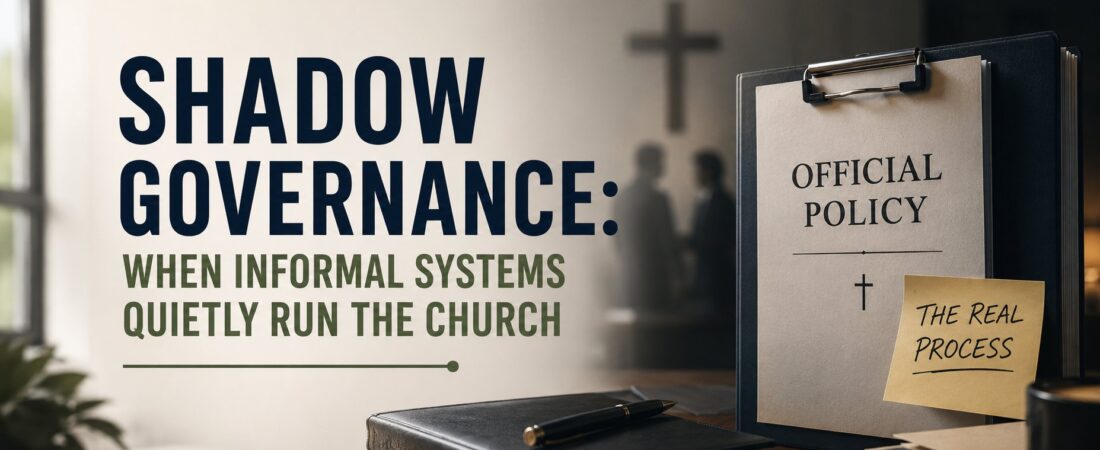
Shadow Governance: When Informal Systems Quietly Run the Church
Every church has both a formal governance system and an actual governance system. The formal system is documented in articles of incorporation, constitutions, bylaws, policies, procedures, committee handbooks, and personnel manuals. The actual system is revealed by observing how decisions are made. In healthy churches, the two systems are closely aligned. Unfortunately, there are often gaps between what is written and what is practiced. That gap is where shadow governance begins to grow.
For example, a church’s policies might require that any expense above a certain amount be approved by the finance committee. Still, church staff often find it easier to check with a trusted, longtime treasurer before making purchases because the committee doesn’t meet often and the treasurer is seen as managing day-to-day operations. While this makes things simpler, some members might wonder who really has the authority or why the formal procedures in the policy manual aren’t being followed. This situation shows how a gap can develop between official rules and what actually happens, creating a kind of shadow governance. What starts as a simple shortcut can end up being the normal way of doing things, even if it’s not officially approved.
Shadow governance is not usually created by rebellious people trying to seize power. Often, this happens because leaders are working hard to keep the ministry moving forward, especially when the formal structures are unclear, outdated, slow, or rarely consulted. At first, it can feel helpful. Over time, it can quietly diminish trust, accountability, and clarity.
Shadow Governance Defined
Shadow governance refers to informal authority systems that function alongside, or sometimes replace, the church’s official decision-making structures. It emerges when unwritten expectations influence policies, personalities take precedence over roles, or longstanding practices become more authoritative than the church’s governing documents.
A trusted staff member becomes the default decision maker because everyone knows he will handle it. A longtime volunteer controls access to a room, resource, or ministry calendar because she has always done it. A committee still acts as if it has authority, even though the bylaws no longer give it that power. A group of influential members shapes major decisions before the proper team ever meets. A pastor, staff member, or lay leader knows the official process, but follows the informal process because that is the only way things actually get done.
In these moments, authority has not disappeared. It has simply moved into places the church may not have named, approved, or understood.
Why Shadow Governance Develops
Shadow governance usually begins with a practical need. Churches are relational communities, and ministry rarely waits for perfect systems. Someone has to answer the question, open the building, approve the expense, call the volunteer, handle the conflict, schedule the room, or respond to a family in need. When the written process is unclear, people fill the gap.
Growing churches face increased decisions as they expand: more staff, volunteers, buildings, and budget flow. Informal systems strain, and shadow governance arises when documents become outdated or ignored. Leaders may overlook bylaws, rely on memory, or take shortcuts, risking clarity and order.
Another cause is high trust. That may sound strange, but trust can hide weak systems. When relationships are strong, informal practices can work for a while. People trust the pastor. The staff trusts one another. Members know the longtime volunteers. The problem is that trust tied only to personalities does not transfer easily. When a leader leaves, a conflict emerges, or trust is strained, the informal system can quickly become a source of confusion.
Common Signs of Shadow Governance
Shadow governance often reveals itself through recurring phrases. Listen for statements like:
- “That is just how we have always done it.”
- “You will need to talk to her about that.”
- “He is the only one who knows how that works.”
- “The bylaws say one thing, but we really do another.”
- “We probably need approval, but I am not sure from whom.”
These statements are diagnostic. They reveal that the actual authority structure may differ from the written one. Shadow governance often appears in areas where decisions must be made quickly. These are usually the places where people are trying to keep the ministry moving, but the written process is unclear, unavailable, or no longer followed. Common examples include:
- Facility use, when the official policy says one thing but the real process is controlled by the person who manages the calendar, holds the keys, or knows the building best.
- Volunteer leadership, when screening requirements exist but are bypassed because a longtime leader “knows the person.”
- Finances, when approval thresholds are unclear, or leaders rely on tradition rather than written authorization.
- Crisis response and benevolence, when decisions need to happen quickly, but there is no clear process for who has the authority to act.
- Scheduling and communications, when the real system depends on who knows whom, rather than a shared process everyone understands.
- Personnel matters, when expectations, authority, or accountability are shaped by informal conversations rather than written policy.
Shadow governance is not always visible from the top. Senior leaders may believe the church is functioning well because major decisions appear to be moving forward.
The Risks of Leaving It Alone
The danger of shadow governance is not merely that it violates a document. The greater danger is that it creates hidden authority. Hidden authority is hard to evaluate, hard to hold accountable, and hard to transfer. It also makes decision-making feel inconsistent. One person gets approval because of a relationship. Another person is told no because they did not know the informal pathway. A staff member is blamed for a decision they did not know someone else had already shaped. A committee believes it has authority, but the staff functions as though it does not.
Over time, these patterns erode trust. People may not be able to name the governance problem, but they feel the effects. Decisions seem unpredictable. Leaders appear selective. Processes feel personal rather than principled. In a church, that kind of confusion has spiritual consequences because it affects unity, credibility, and the way people experience leadership.
Shadow governance can also make leadership transitions difficult. When a church depends on the memory or influence of specific people, those people become load-bearing walls. If they leave, move, resign, burn out, or lose trust, the process they carried out may collapse. What looked efficient was actually fragile.
Bringing Shadow Governance Into the Light
Addressing shadow governance should not begin with blame. In most cases, informal authority emerged because someone was trying to help. The goal is not to embarrass trusted leaders or strip faithful servants of influence. The goal is to honor healthy influence by placing it within clear structures.
A good first step is observation. Where do decisions actually happen? Who do people go to when they need approval? Which decisions require a formal vote, and which are handled by staff? What practices function like policy even though they have never been approved? Where do people disagree about who has authority?
The next step is comparison. Place the actual process beside the written process. If the written process is right but ignored, leaders need implementation and accountability. If the actual process is healthier than the written one, leaders may need to revise the documents. If neither process is clear, the church needs to develop a better system.
Then clarify ownership. Every recurring responsibility should be connected to a role, not merely to a person. A person may fill the role, but the role should be understandable apart from that person. Who is responsible? Who has authority? Who must be consulted? Who should be informed? Where is the process written? If the current person stepped away, would the church know what to do?
The Role of Policies and Procedures
Policies and procedures are one of the most practical ways to reduce shadow governance. Policies state what should happen. Procedures explain how it happens. Together, they turn assumptions into shared expectations.
For example, a facility policy may state who may use church facilities and under what conditions. The procedure explains how requests are submitted, who approves them, how fees or insurance requirements are handled, who unlocks the building, and how the event is placed on the calendar. Without that clarity, the real policy becomes whoever answers the phone or controls the calendar.
A volunteer screening policy may state that anyone serving with minors must complete an application, background check, reference process, and training. The procedure explains how those steps happen and who verifies completion. Without that clarity, exceptions become easier and risk increases.
A financial policy may define approval limits and accountability. The procedure explains purchase requests, reimbursements, credit card use, documentation, and reporting. Without that clarity, leaders may unintentionally rely on trust instead of stewardship.
How to Talk About It Without Creating Conflict
Governance conversations can feel threatening because they touch power, history, and identity. Leaders should frame the conversation carefully. Shadow governance is not a charge against the people who have carried the ministry. It is a recognition that the church has outgrown its current systems and needs greater clarity for future health.
Helpful language matters. Consider these examples: Instead of saying,
- “You have been making decisions you should not make,” say, “We are working to ensure our written process is consistent with how the ministry needs to function today.”
- “This committee has no authority,” say, “We need to clarify where this responsibility belongs so everyone can serve with confidence.”
- “We are fixing the past,” say, “We are strengthening the church for the future.”
The tone needs to be pastoral, not prosecutorial. The best governance work reduces anxiety. It helps people know where they stand, how decisions are made, and how they can serve well.
Conclusion
Shadow governance grows when informal authority fills the space left by unclear structures. It often begins as a practical solution, but when it remains hidden, it can create confusion, inconsistency, and unnecessary conflict. Healthy churches will always depend on faithful people, but faithful people should not have to carry systems that exist only in their memory. Bringing shadow governance into the light is an act of stewardship and care. It honors those who have served, protects the church, prepares future leaders, and helps the congregation move forward with greater clarity and unity.
Questions for Church Leaders
1. Where do decisions actually happen in our church?
2. Do those decision points match our bylaws, policies, and procedures?
3. What practices function like policy even though they have never been formally approved?
4. Are there trusted individuals who carry authority because of history rather than a defined role?
5. If a key staff member or volunteer stepped away, what processes would become unclear immediately?
About the Author
Brad Gwartney, DMin, serves as Executive Pastor of Stetson Baptist Church in DeLand, Florida. He has more than 25 years of ministry experience in local church leadership, administration, operations, and governance. Brad is the author of Faithful and Clear: A Pastor’s Guide to Church Governance, a practical resource designed to help pastors and church leaders strengthen constitutions, bylaws, policies, and procedures. He also serves as a trustee of the Ethics and Religious Liberty Commission of the Southern Baptist Convention. Brad and his wife, June, have two children, Lydia and Will. To learn more about Faithful and Clear or to access free church governance resources, visit www.bradgwartney.com. To contact Brad directly, email him at brad.gwartney@gmail.com.
Also published on XPastor.