
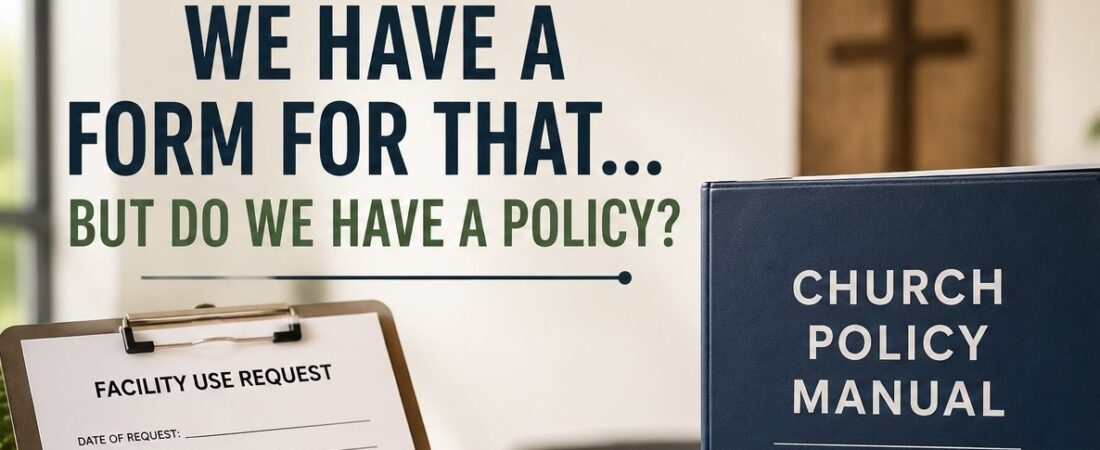
We Have a Form for That… But Do We Have a Policy?
A new pastor walks into the church office and asks a simple question.
“Who approves requests for people to use the building?”
The office manager answers quickly, “Usually I do. If it seems like a bigger request, I ask one of the pastors.”
“That makes sense,” the pastor replies. “Where is the policy that explains who can use the building, who approves it, and what expectations they have to meet?”
The office manager pauses.
“Well, we have a form they fill out. And we have always handled it this way.”
That moment reveals a common problem in church life. The procedure may be working. Requests are being received. Rooms are being scheduled. Doors are being unlocked. Faithful people may be doing their best to steward the building well. But if there is no approved policy behind the procedure, the church is depending on habit rather than clarity.
That does not mean anyone has done something wrong. In many cases, these practices developed because someone was trying to help. A need arose, a leader responded, and over time, the response became the normal way of doing things. The church had a procedure, but the procedure was not clearly supported by policy.
Eventually, a growing church must ask a deeper question: Is this just what we do, or is this what the church has approved?
The question, “Where is the written policy for…?” became more than an administrative question for me. It became one of the driving questions behind my doctoral work. I began to realize that many churches, including those with faithful leaders and healthy intentions, have procedures they follow but lack written policies to support them. The church may have a way of doing things, but it may not have an approved policy explaining what should happen, who has authority, and how that decision should be carried out.
That gap matters.
Paul reminded the Corinthian church, “For God is not a God of confusion but of peace” (1 Corinthians 14:33 ESV). A few verses later, he wrote, “But all things should be done decently and in order” (1 Corinthians 14:40 ESV). These verses are frequently cited in discussions about worship, but the principle extends to the broader life of the church. Order does not replace the work of the Spirit. When rightly understood, order helps protect unity, reduce confusion, and keep the church focused on its mission.
A policy manual is one practical way a church pursues that kind of order.
Procedures Without Policies
Most churches have more procedures than they realize.
Someone knows:
- How to reserve a room
- Who can approve a purchase
- What happens when a benevolence request comes in
- Who has keys to the building
- What forms need to be completed before a volunteer serves with children
- How to handle a severe weather decision
The problem is not always that the church has no process. The problem is that the process may not be tied to an approved policy.
A procedure explains how something happens. A policy explains what should happen, who has authority, and what boundaries guide the decision. Both are important, but they are not the same.
Think again about facility use. A church may have a form. The form may ask for the date, time, room, number of people, and setup needs. The office may know where to file it. The facilities team may know how to unlock the room and adjust the air conditioning. That is a procedure.
But the policy answers bigger questions:
- Who may use the facility?
- Are outside groups permitted?
- What kinds of events are consistent with the church’s beliefs and mission?
- Who approves exceptions?
- Are there insurance requirements?
- Are there security expectations?
- Who is responsible for cleaning, supervision, and damage?
- Who has final authority when there is a question?
Without a written policy, the procedure can become whatever the current staff member, volunteer, or calendar manager believes it should be. One request may be approved because it feels reasonable. Another may be denied because it feels uncomfortable. One person may receive an exception because they know who to ask. Another may be frustrated because they did not understand the informal pathway.
The same issue appears in many areas of church life. A church may have a process for approving reimbursements, but no financial policy that explains spending authority. A church may have a practice for helping families in need, but no benevolence policy clarifying who qualifies and who approves assistance. A church may run background checks for volunteers, but no child protection policy stating that screening is required before anyone serves with minors.
In each case, the church may have a procedure, but the procedure needs the support of an approved policy.
Why This Creates Confusion
Unwritten policies usually begin in practical ways. Someone sees a need and solves it. Over time, that helpful response becomes the way things are done.
This works for a while, especially when trust is high. People know each other. The system feels simple because everyone knows the people involved.
But memory is not the same as governance.
When a church depends on memory, the process becomes fragile. If the person who knows the process leaves, retires, moves, burns out, or loses trust, the process can collapse. What looked efficient was dependent on one person carrying information that should have belonged to the church.
This is also where inconsistency begins to grow. Decisions start to feel personal rather than principled. People may not know why one request was approved and another was denied. Staff members may not know whether they have the authority to act. Committees may assume they still have authority because they always have. Volunteers may follow a practice that was never formally approved.
Most of the time, this is not caused by rebellion or bad motives. It happens because ministry moves quickly, and people are trying to keep things going. Churches are relational communities, and ministry rarely waits for perfect systems. Someone must answer the phone, unlock the building, approve the request, schedule the room, or respond to the crisis.
But when those decisions are not connected to clear policies, the church slowly begins to depend on informal authority. The person who controls the calendar may become the real facility-use decision maker. The person who has always handled reimbursements may become the real financial gatekeeper. The person everyone trusts may become the policy, even when no policy has been approved.
A policy manual helps bring these informal systems into the light.
A Policy Manual Is Not About Bureaucracy
Some church leaders hear the words “policy manual” and immediately think of red tape. They picture a binder full of rules that slows ministry down and makes the church feel more corporate than spiritual.
That is not the goal.
A healthy policy manual is not about controlling people. It is about creating clarity so people can serve with confidence. It does not exist to make ministry harder. It exists to help ministry happen with trust, consistency, and care.
Good policies protect the church by:
- Clarifying expectations before confusion develops.
- Empowering leaders by giving them an approved framework for action.
- Helping volunteers know how to serve well.
- Helping staff members make decisions without carrying every question personally.
- Helping committees understand their role.
- Helping the congregation trust that similar situations are handled consistently.
A policy manual also safeguards committed leaders. When a decision is supported by an approved policy, leaders aren’t required to justify each choice as a matter of personal preference. They can simply say, “This is the process our church has approved.” This clarity diminishes uncertainty and reinforces the idea that clarity is kindness.
Policies do not remove the need for prayer, wisdom, humility, or pastoral care. Policies should never be used as a substitute for shepherding people. But policies do provide a shared starting point, especially when emotions are high, expectations differ, or the decision involves risk.
Policy Support for Policies
One of the most important policies a church can adopt is a policy about policies.
That may sound strange, but it is essential. Before a church can build a helpful policy manual, it needs to answer a foundational question: Who has authority to approve policy?
The answer will not be the same in every church. It depends on the church’s governing documents. In some churches, final authority may rest with the congregation. In others, certain responsibilities may be delegated to elders, a church council, deacons, trustees, a personnel committee, a finance committee, or another leadership body. In a congregational church, delegated authority should still fit within the church’s constitution and bylaws and remain accountable to the congregation.
This is where churches can get confused. A committee may create a policy that no one else has approved. A staff member may write expectations that function like policy but were never reviewed. A ministry team may enforce a practice that conflicts with the bylaws. A church may have old policies approved under a previous structure that no longer align with the current one.
A policy manual should make the approval pathway clear. Who may propose a new policy? Who reviews the draft? When should staff, committees, ministry leaders, legal counsel, insurance representatives, or outside experts be consulted? Who has final approval? How is the policy communicated? Where is it stored? Who is responsible for implementation? When will it be reviewed?
This became a major part of my doctoral work. At Stetson Baptist Church, our bylaws assigned responsibility for maintaining policies to the Church Council, but the process for developing and reviewing policies needed greater clarity. We needed more than a list of policies. We needed a process for how policies would be created, approved, implemented, and reviewed.
That process matters because policies should not appear simply because one person thought they were needed. They should be developed with appropriate input, reviewed carefully, approved by the proper leadership entity, communicated to those affected, and revisited regularly.
A church should not only have policies. It should have an approved process for maintaining them.
What Should Be Included in a Policy Manual?
A policy manual does not need to include everything at once. Trying to write every possible policy immediately can overwhelm leaders and stall the process. A church should begin with the areas where clarity is most needed, risk is highest, or confusion is most common.
Most churches should consider several broad categories.
- Governance and authority policies clarify how decisions are made, including delegation of authority, committee responsibilities, approval thresholds, conflict of interest, document retention, and the policy development process itself.
- Financial policies help the church steward resources with integrity. These may include budgeting, spending approvals, reimbursements, credit cards, counting procedures, designated gifts, audits or financial reviews, fraud prevention, and financial reporting.
- Personnel, volunteer, and safety policies guide the church in caring for people and protecting those who serve. These may include hiring, employee conduct, volunteer expectations, screening, training, child protection, emergency response, security, incident reporting, and abuse prevention.
- Facility, property, and ministry management policies clarify how church property is used and how recurring ministry decisions are made. These may include facility use, outside groups, weddings, funerals, keys and access, maintenance, benevolence, transportation, communications, privacy, technology use, social media, and ministry events.
Not every church needs the same manual. A smaller church may need a simpler set of policies. A larger church, a church with a school, a multisite church, or a church with extensive facilities may need a more developed manual. The goal is not to copy another church’s manual. The goal is to build a manual that fits the church’s ministry, governing documents, and risk environment.
How a Policy Manual Should Be Formatted
A policy manual should be easy to find, easy to understand, and easy to maintain. If the manual is confusing, outdated, or buried in a folder no one can access, it will not help the church.
Each policy should have a clear title, approving body, approval date, revision date when applicable, purpose, scope, and statement of policy. When needed, it should identify the role or ministry responsible for implementation and point to related procedures, forms, handbooks, or legal documents.
The distinction between policy and procedure should remain clear. A policy should not try to include every step, exception, and form. Policies should establish expectations and authority. Procedures should explain how those expectations are carried out.
For example, a facility-use policy may state who may use the building, what kinds of use are allowed, who has approval authority, and what conditions must be met. The procedure may explain how to submit a request, where to find the form, who reviews it, how approval is documented, how to add the event to the calendar, and who unlocks the building.
That distinction keeps the policy stable while allowing procedures to be updated as tools, staff, systems, and ministry realities change.
The manual should also be organized by category, with a single official version. Churches should avoid multiple unofficial copies floating around in email folders, old binders, or personal computers.
Reviewing and Maintaining the Manual
A policy manual is only helpful if it is maintained.
Churches change. Ministries grow. Staff structures shift. Laws and insurance expectations change. Technology creates new challenges. A policy that was clear ten years ago may no longer fit the church’s current reality.
For that reason, every policy manual should include an annual or biannual review process. The review should ask whether the policies are still accurate, understandable, accessible, and aligned with current ministry practice. Leaders should ask whether policies are being followed, whether procedures exist to support them, and whether staff and volunteers know where to find them.
The review process should include feedback from those closest to the ministry. Staff members, ministry leaders, committees, finance leaders, children’s and student ministry leaders, and facilities leaders often know where policies need clarification.
Some policies should also be reviewed with outside help. Legal counsel, insurance representatives, denominational resources, and field experts can provide important guidance, especially in areas involving employment, child protection, finances, facilities, safety, and risk.
The review process should not be treated as an admission of failure. It is an act of stewardship. A church that reviews its policies is acknowledging that governance documents are living tools that need ongoing care.
Encouragement to Church Leaders
Building a policy manual can feel overwhelming, but churches do not have to fix everything at once.
Start by gathering what already exists. Then ask a simple question: What are we currently doing that functions like policy but has never been clearly written, reviewed, or approved?
From there, prioritize. Begin with the areas that create the most confusion, carry the greatest risk, or affect the most people. Do not write policies merely to fill a binder. Write policies that help the church serve people faithfully.
The tone of this work matters. Governance conversations can feel threatening because they touch on history, authority, and identity. Leaders should not approach this work as if they were accusing faithful people of wrongdoing. In many cases, informal systems developed because people were trying to help.
A pastoral approach says, “We are not trying to fix the past. We are trying to strengthen the church for the future.”
So, return to that simple facility-use question.
“Who approves requests for people to use the building?”
It may be that the church has a good answer. It may have a good form, a good calendar process, and a faithful person who has handled those requests well for years. But the next question still matters.
“Where is the policy?”
If the answer is “in someone’s head,” “in an old folder,” “we have always done it this way,” or “I am not sure,” then it may be time to begin the work.
Gather what you have. Clarify who has authority. Write what needs to be written. Review what needs to be reviewed. Build a manual that serves the church.
Not because paperwork is the mission.
Because clarity helps ministry flourish.
About the Author
Brad Gwartney, DMin, serves as Executive Pastor of Stetson Baptist Church in DeLand, Florida. He has more than 25 years of ministry experience in local church leadership, administration, operations, and governance. Brad is the author of Faithful and Clear: A Pastor’s Guide to Church Governance, a practical resource designed to help pastors and church leaders strengthen constitutions, bylaws, policies, and procedures. He also serves as a trustee of the Ethics and Religious Liberty Commission of the Southern Baptist Convention. Brad and his wife, June, have two children, Lydia and Will. To learn more about Faithful and Clear or to access free church governance resources, visit www.bradgwartney.com. To contact Brad directly, email him at brad.gwartney@gmail.com.